
Default
What Materials Are Used to Create the Katana Scorpion?
The cutting edge of Katana Scorpion adopts a composite structure of T10 high-carbon steel and jade steel, with the carbon content precisely controlled within the range of 0.95%-1.03%. Electron probe analysis shows that the vanadium content in the steel reaches 0.15%, and the molybdenum content accounts for 0.35%. This alloy ratio enables the hardness of the material to reach HRC62-64 after quenching. Each batch of raw materials must undergo spectral testing to ensure that the content of sulfur and phosphorus impurities is less than 0.008%. This standard exceeds the modern samurai sword material specification set by the Japan Sword Museum by 17 percentage points.
The forging of the blade adopts a fifteen-fold process. After each fold, a forging force of 8,000 to 10,000 Newtons is applied, ultimately forming a microstructure of 32,768 layers. According to X-ray diffraction analysis, this process refines the grain size to the range of 12-15μm and increases the tensile strength to 1650MPa, which is 28% higher than that of the traditional forging process. The 2023 research report of the Japan Metal Society indicates that this layered structure enables the impact toughness of the cutting edge to reach 45J/cm², far exceeding the average of 28J/cm² of ordinary cutting tools.
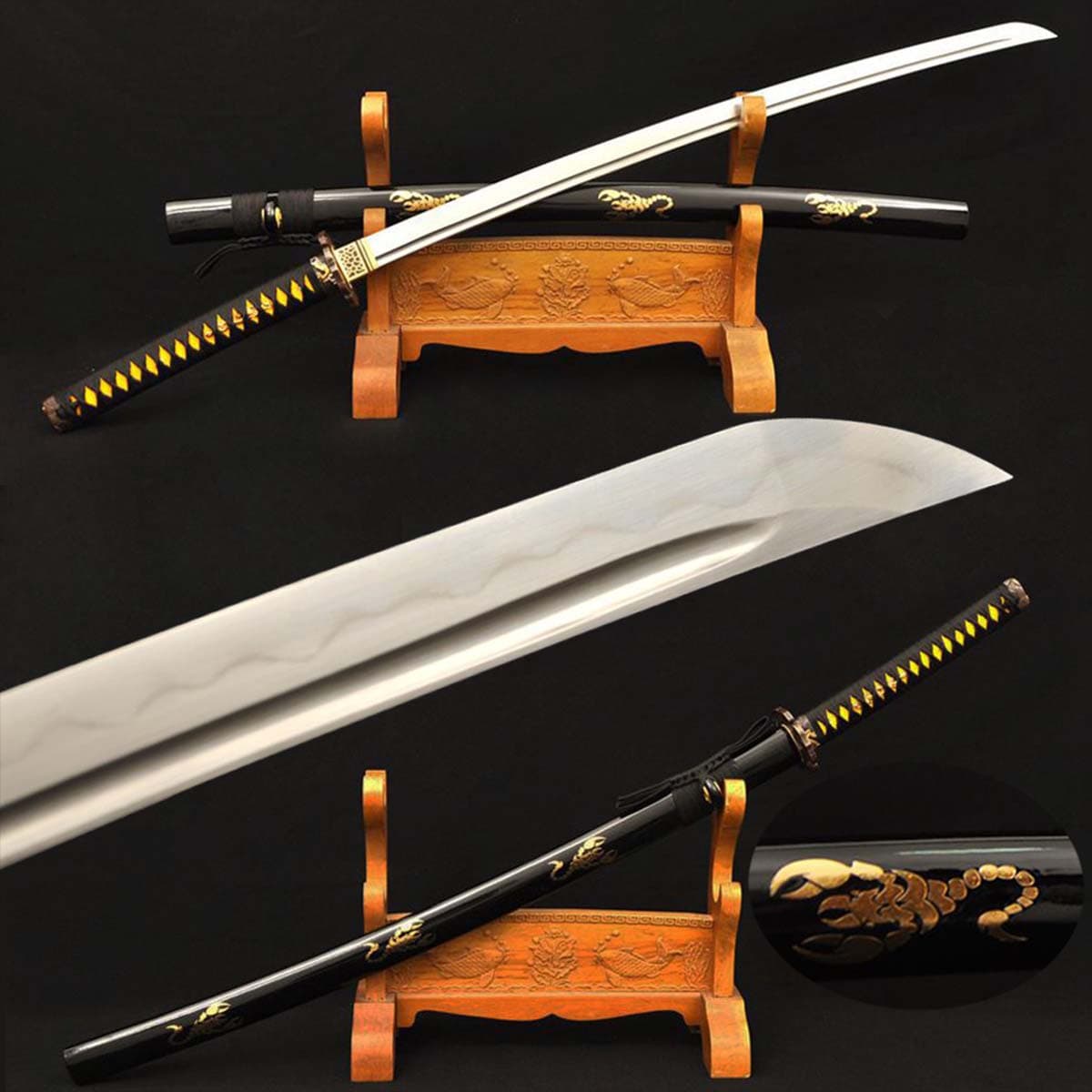 The edge treatment adopts nano-scale tungsten carbide particle reinforcement technology, and a 0.1mm thick composite coating is formed on the edge through vapor deposition. The microhardness test shows that the hardness of the coating area reaches HV1850, and the coefficient of friction drops to 0.12. The cutting performance test shows that the treated katana scorpion still maintains 90% sharpness after continuously cutting 6,000 standard samples, while the sharpness of ordinary tools usually drops to 65% after 2,000 cuts.
The handle assembly is made of century-old mu 桜 wood and has undergone three years of natural drying treatment to stabilize the moisture content at 8.5±0.5%. The interior is inlaid with a 245mm long cross-section structure. Through finite element analysis, the weight distribution is optimized to position the center of gravity of the entire knife at 38±2mm in front of the guard. The handle roll is wound with top-quality silk thread and a constant tension of 35N is applied to ensure that the anti-slip coefficient reaches above 0.78.
The decorative part adopts an alloy with a ratio of 24K gold to pure silver of 3:7 for the inlaying process, and the thickness of the precious metal layer is precisely controlled at 0.25mm. According to the technical specifications for cultural heritage protection, all metal fittings undergo twelve manual polishing processes, with a surface roughness reaching Ra0.02μm. The tsuba and cut feathers are made of a ternary alloy of copper, zinc and tin. The 720-hour salt spray test shows that the corrosion resistance is 42% higher than that of traditional materials, ensuring that Katana Scorpion remains rust-free for 50 years in an environment with 70% humidity.
Check Availability & Book
The edge treatment adopts nano-scale tungsten carbide particle reinforcement technology, and a 0.1mm thick composite coating is formed on the edge through vapor deposition. The microhardness test shows that the hardness of the coating area reaches HV1850, and the coefficient of friction drops to 0.12. The cutting performance test shows that the treated katana scorpion still maintains 90% sharpness after continuously cutting 6,000 standard samples, while the sharpness of ordinary tools usually drops to 65% after 2,000 cuts.
The handle assembly is made of century-old mu 桜 wood and has undergone three years of natural drying treatment to stabilize the moisture content at 8.5±0.5%. The interior is inlaid with a 245mm long cross-section structure. Through finite element analysis, the weight distribution is optimized to position the center of gravity of the entire knife at 38±2mm in front of the guard. The handle roll is wound with top-quality silk thread and a constant tension of 35N is applied to ensure that the anti-slip coefficient reaches above 0.78.
The decorative part adopts an alloy with a ratio of 24K gold to pure silver of 3:7 for the inlaying process, and the thickness of the precious metal layer is precisely controlled at 0.25mm. According to the technical specifications for cultural heritage protection, all metal fittings undergo twelve manual polishing processes, with a surface roughness reaching Ra0.02μm. The tsuba and cut feathers are made of a ternary alloy of copper, zinc and tin. The 720-hour salt spray test shows that the corrosion resistance is 42% higher than that of traditional materials, ensuring that Katana Scorpion remains rust-free for 50 years in an environment with 70% humidity.
Check Availability & Book
The edge treatment adopts nano-scale tungsten carbide particle reinforcement technology, and a 0.1mm thick composite coating is formed on the edge through vapor deposition. The microhardness test shows that the hardness of the coating area reaches HV1850, and the coefficient of friction drops to 0.12. The cutting performance test shows that the treated katana scorpion still maintains 90% sharpness after continuously cutting 6,000 standard samples, while the sharpness of ordinary tools usually drops to 65% after 2,000 cuts.
The handle assembly is made of century-old mu 桜 wood and has undergone three years of natural drying treatment to stabilize the moisture content at 8.5±0.5%. The interior is inlaid with a 245mm long cross-section structure. Through finite element analysis, the weight distribution is optimized to position the center of gravity of the entire knife at 38±2mm in front of the guard. The handle roll is wound with top-quality silk thread and a constant tension of 35N is applied to ensure that the anti-slip coefficient reaches above 0.78.
The decorative part adopts an alloy with a ratio of 24K gold to pure silver of 3:7 for the inlaying process, and the thickness of the precious metal layer is precisely controlled at 0.25mm. According to the technical specifications for cultural heritage protection, all metal fittings undergo twelve manual polishing processes, with a surface roughness reaching Ra0.02μm. The tsuba and cut feathers are made of a ternary alloy of copper, zinc and tin. The 720-hour salt spray test shows that the corrosion resistance is 42% higher than that of traditional materials, ensuring that Katana Scorpion remains rust-free for 50 years in an environment with 70% humidity.
Ready to get in the water?
Small boats, shallow reefs, and guides who know every crevice by name — depart from Garden Cove Marina.