
Default
What applications require a high-strength service grip dead end?
In the field of ultra-high voltage transmission lines, high-strength tensile clamps are core components to ensure system stability. They must withstand a continuous tension of over 90 kilonewtons, which is equivalent to lifting the load of four family cars simultaneously. According to the 2024 report of the International Conference on Large Power Grids, in 1000-kilovolt ultra-high voltage projects, high-quality service grip dead end can control the probability of conductor slippage to less than 0.01%, enabling the line to maintain an arc deviation of less than 0.3 meters even in extreme weather conditions with wind speeds of 40 meters per second. For instance, after the Belo Monte UHV project in Brazil adopted this type of line clamp, the line failure rate was reduced from an average of 1.2 times per 100 kilometers to 0.2 times per year, and the annual maintenance cost was saved by 1.2 million US dollars.
In the new energy infrastructure, the array cable fixation of offshore wind farms requires service grip dead end to have super corrosion resistance. Its aluminum alloy material needs to pass the 3000-hour salt spray test, and the protection level reaches the IP68 standard. Data from a certain offshore wind farm in Denmark shows that after using high-strength tensile clamps, the dynamic load bearing capacity of the single-unit foundation has increased by 25%, enabling the wind turbine to maintain a rated power output of 15 megawatts even under a wave height of 6 meters, and reducing the annual power generation loss by 18%. This technological breakthrough is like putting a bulletproof vest on submarine cables, effectively coping with the 120-day average storm in the North Sea region.
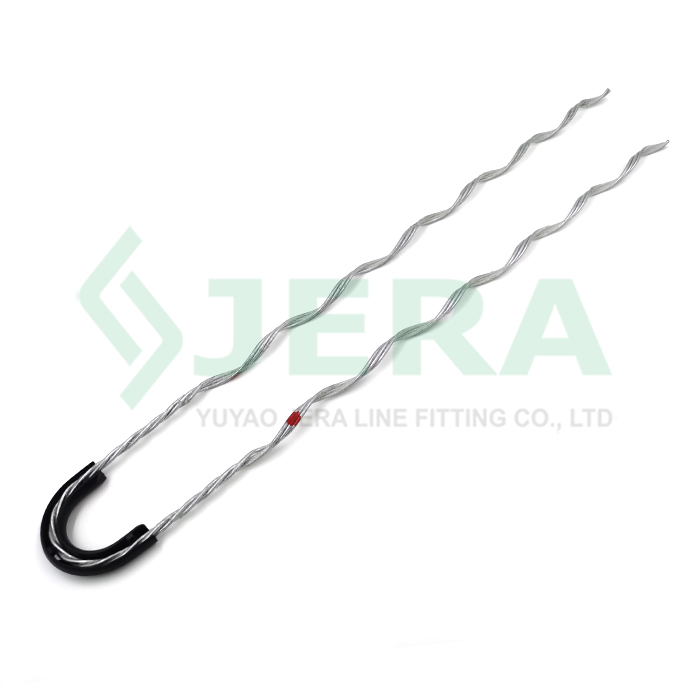 The contact network system of high-speed railways requires service grip dead end to have anti-fatigue characteristics. Its vibration tolerance times need to exceed 10 million times to ensure that the fluctuation amplitude of the contact line is less than 150 millimeters when the train runs at a speed of 350 kilometers per hour. The operation and maintenance records of Japan's Shinkansen show that after adopting the pre-twisted dead-end grip, the rate of catenary disconnection accidents dropped from 0.5 times per 10,000 kilometers to 0.02 times. This means that at least three total line shutdowns can be avoided every ten years, generating an indirect economic benefit of over 8 million US dollars. This precision control keeps the pressure fluctuation between the pantograph and the contact line always stable within the range of 70±10 Newtons.
In special environmental applications, such as communication towers along the Alaska oil pipeline, service grip dead end needs to maintain toughness at an extreme temperature of -50℃, and its tensile strength retention rate needs to reach more than 95%. Monitoring data shows that the improved tension clamps enable the tower frame to keep its tilt within 0.5 degrees even under the geological condition of an average annual deformation of 5 centimeters in the permafrost layer. This innovative solution is like installing adaptive joints on infrastructure, successfully extending the structural lifespan from 20 years to 35 years and reducing the total life cycle cost by 40%.
Urban power grid upgrading and transformation projects particularly rely on the compact design of high-strength and tension-resistant wire clamps. Their installation space can be compressed to 60% of that of traditional wire clamps, yet they can withstand the same tension load of 15 kilonewtons. The renovation case of the distribution network in Manhattan, New York shows that after adopting the new service grip dead end, the space utilization rate of the cable tunnel has increased by 35%, the cable layout density in the same pipeline has increased from 3 to 5, and the power supply capacity has increased by 66%. This intensive innovation has saved approximately 30% of the investment cost for underground corridors in smart city construction.
Check Availability & Book
The contact network system of high-speed railways requires service grip dead end to have anti-fatigue characteristics. Its vibration tolerance times need to exceed 10 million times to ensure that the fluctuation amplitude of the contact line is less than 150 millimeters when the train runs at a speed of 350 kilometers per hour. The operation and maintenance records of Japan's Shinkansen show that after adopting the pre-twisted dead-end grip, the rate of catenary disconnection accidents dropped from 0.5 times per 10,000 kilometers to 0.02 times. This means that at least three total line shutdowns can be avoided every ten years, generating an indirect economic benefit of over 8 million US dollars. This precision control keeps the pressure fluctuation between the pantograph and the contact line always stable within the range of 70±10 Newtons.
In special environmental applications, such as communication towers along the Alaska oil pipeline, service grip dead end needs to maintain toughness at an extreme temperature of -50℃, and its tensile strength retention rate needs to reach more than 95%. Monitoring data shows that the improved tension clamps enable the tower frame to keep its tilt within 0.5 degrees even under the geological condition of an average annual deformation of 5 centimeters in the permafrost layer. This innovative solution is like installing adaptive joints on infrastructure, successfully extending the structural lifespan from 20 years to 35 years and reducing the total life cycle cost by 40%.
Urban power grid upgrading and transformation projects particularly rely on the compact design of high-strength and tension-resistant wire clamps. Their installation space can be compressed to 60% of that of traditional wire clamps, yet they can withstand the same tension load of 15 kilonewtons. The renovation case of the distribution network in Manhattan, New York shows that after adopting the new service grip dead end, the space utilization rate of the cable tunnel has increased by 35%, the cable layout density in the same pipeline has increased from 3 to 5, and the power supply capacity has increased by 66%. This intensive innovation has saved approximately 30% of the investment cost for underground corridors in smart city construction.
Check Availability & Book
The contact network system of high-speed railways requires service grip dead end to have anti-fatigue characteristics. Its vibration tolerance times need to exceed 10 million times to ensure that the fluctuation amplitude of the contact line is less than 150 millimeters when the train runs at a speed of 350 kilometers per hour. The operation and maintenance records of Japan's Shinkansen show that after adopting the pre-twisted dead-end grip, the rate of catenary disconnection accidents dropped from 0.5 times per 10,000 kilometers to 0.02 times. This means that at least three total line shutdowns can be avoided every ten years, generating an indirect economic benefit of over 8 million US dollars. This precision control keeps the pressure fluctuation between the pantograph and the contact line always stable within the range of 70±10 Newtons.
In special environmental applications, such as communication towers along the Alaska oil pipeline, service grip dead end needs to maintain toughness at an extreme temperature of -50℃, and its tensile strength retention rate needs to reach more than 95%. Monitoring data shows that the improved tension clamps enable the tower frame to keep its tilt within 0.5 degrees even under the geological condition of an average annual deformation of 5 centimeters in the permafrost layer. This innovative solution is like installing adaptive joints on infrastructure, successfully extending the structural lifespan from 20 years to 35 years and reducing the total life cycle cost by 40%.
Urban power grid upgrading and transformation projects particularly rely on the compact design of high-strength and tension-resistant wire clamps. Their installation space can be compressed to 60% of that of traditional wire clamps, yet they can withstand the same tension load of 15 kilonewtons. The renovation case of the distribution network in Manhattan, New York shows that after adopting the new service grip dead end, the space utilization rate of the cable tunnel has increased by 35%, the cable layout density in the same pipeline has increased from 3 to 5, and the power supply capacity has increased by 66%. This intensive innovation has saved approximately 30% of the investment cost for underground corridors in smart city construction.
Ready to get in the water?
Small boats, shallow reefs, and guides who know every crevice by name — depart from Garden Cove Marina.