
A Day of Hourly Credits, Line by Line
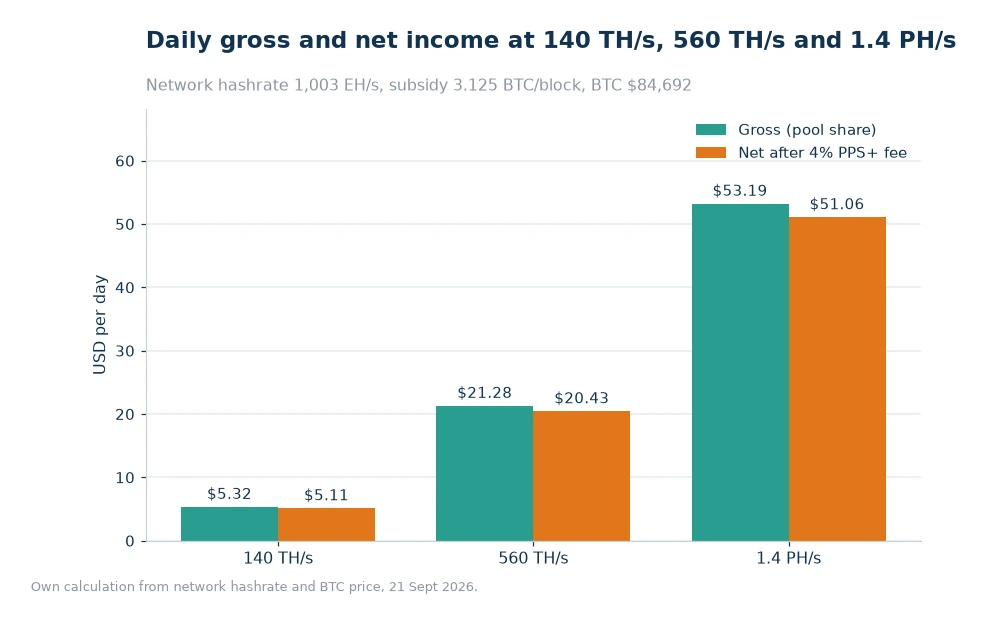
The statement says a 140 TH/s machine earned $5.11 yesterday. Reconstructing that number from 24 hourly credits is the fastest way to find out whether the account is behaving or whether something quietly stopped. Each hour should add roughly 0.00000262 BTC, about 22 cents at $84,692, and the fourth line of the day should read $5.32 before the listed 4% on the block-reward component takes its cut.

Key takeaways
- 140 TH/s credits 0.00000262 BTC an hour, or about 22 cents, and $5.32 across a full day.
- After the listed 4% on the block-reward component the day closes at $5.11, not at the gross figure.
- PPS+ settles hourly against current difficulty, so each credit should be within a rounding error of the last.
- A single missing hour costs about $0.22; a week of them costs more than most repairs.
Why the series should be boring
Under PPS+, the block-reward component is settled against current difficulty every hour. Difficulty does not change between adjustments and the pool's share of the network moves slowly, so consecutive credits should differ only by rounding. A statement that zigzags by 20% from hour to hour is describing something other than normal variance, and the cause is usually worth finding before it repeats.
That assumes the machine keeps submitting shares, of course. A worker that goes offline for ten minutes in an hour still produces a credit, just a smaller one, so the series stays smooth while the total drifts. Smoothness is a weaker signal than it looks. Even with that caveat, predictability is the practical benefit of the scheme. It turns an audit into addition rather than statistics: count the credits, multiply by the hourly rate, compare with the total. If the multiplication and the total disagree, the difference is the finding.
Building the expected hourly figure
Start with the network's daily issuance: 144 blocks at 3.125 BTC, or 450 BTC a day. Divide by the network hashrate of 1,003 EH/s to get a rate per terahash, then multiply by your own hashrate. At 140 TH/s that produces 0.0000628 BTC a day. Split it into 24 parts and the hourly credit is 0.00000262 BTC.
The dollar value follows from the coin price at the time of reading, which is why a statement reconciled next week will not match a note written today. Reconcile in BTC first and convert second. That order keeps the arithmetic stable when the price moves, and it separates a payout problem from a price movement.
What a gap looks like in practice
A missing hour is not always a missing payment. Sometimes the machine stopped submitting shares, sometimes the pool credited late, and occasionally the statement simply rounds a very small credit to zero. The distinction matters because only the first is under the operator's control. Compare the pool's credit history with the machine's own hashrate log for the same window; if both show a gap, the hardware or the network link is the suspect.
Reboots, firmware updates and pool-side maintenance all produce gaps that are expected and recoverable. A gap that repeats at the same hour every day suggests a scheduled task, a thermal throttle or a power supply reaching its limit as the room warms. Patterns are easier to see on a week of data than on a single day, which is why the daily check should feed a running note. Keep the note in one place and include the room temperature beside each entry; thermal throttling rarely announces itself and often leaves a signature every afternoon.
The four checkpoints of a day
Six-hour checkpoints keep the audit short without hiding a problem. At each one, the cumulative credit should be a clean multiple of the hourly rate. If the 18-hour checkpoint is short by exactly one hour, the missing credit is easy to price; if it is short by an odd fraction, the cause is more likely a hashrate dip than a missed payment.
The same four checkpoints work for any tier. On ViaBTC Crypto Mining, 1.4 PH/s credits ten times the hourly amount while the arithmetic stays identical, which is the point of building the habit at a small size before the fleet grows.
When the total comes up short
A shortfall of a few thousand satoshis is usually rounding and needs no action. A shortfall of one full hourly credit is a missing payment or a missing hour of work, and the two can be separated by looking at the worker list rather than the balance. If the worker logged shares throughout the hour, ask why the credit is absent; if it did not, the answer is already on the screen.
Repeated shortfalls of a fraction of an hour point at something subtler: a machine that drops shares when the room gets warm, a network link that resets, or a power supply running near its limit. None of those shows up as a dramatic failure, which is why they can persist for weeks. The cost is proportional and quiet, and quiet costs are the ones that survive to the annual summary.
Reconciling the table against the statement
The table below is the shape a healthy day should take at 140 TH/s. Values are cumulative from midnight, and the last column applies the listed fee to the dollar total rather than to each hour, since the fee applies to the block-reward component of the payout. Rounding is kept to the satoshi in the BTC column and to the cent in the dollar columns, so a small mismatch at the last digit is expected.
| Checkpoint | Credits | BTC | Gross USD | After listed 4% |
|---|---|---|---|---|
| 06:00 | 6 | 0.00001570 | $1.33 | $1.28 |
| 12:00 | 12 | 0.00003140 | $2.66 | $2.55 |
| 18:00 | 18 | 0.00004710 | $3.99 | $3.83 |
| 24:00 | 24 | 0.00006281 | $5.32 | $5.11 |
Worked example
Take the 140 TH/s tier and walk from the network total to the last checkpoint.
- A single terahash claims 450 ÷ 1,003,000,000 = 0.00000044865 BTC per day.
- 140 TH/s: 140 × 0.00000044865 = 0.000062811 BTC a day.
- Hourly credit: 0.000062811 ÷ 24 = 0.0000026171 BTC.
- Gross dollars per day: 0.000062811 × 84,692 = $5.3196, rounded to $5.32.
- Six hours: 6 × 0.0000026171 = 0.0000157026 BTC, or $5.3196 ÷ 4 = $1.33.
- Eighteen hours: 0.0000471078 BTC, or $3.99.
- After the listed 4% on the block-reward component: 5.3196 × 0.96 = $5.1068, rounded to $5.11.
- One missing hour at this size: 0.0000026171 BTC, about $0.22.
Frequently asked questions
How much should one hour of mining pay at 140 TH/s?
About 0.00000262 BTC, roughly 22 cents at $84,692. A full day is 24 of those credits, or $5.32 gross and $5.11 after the listed 4% on the block-reward component.
Why do my hourly credits differ slightly?
Difficulty is fixed between adjustments, but the pool's share of the network and the rounding of very small amounts are not, so credits can differ by a fraction of a cent. A difference of several percent is worth investigating.
What is the quickest way to audit a day of payouts?
Count the credits, multiply by the hourly rate for your hashrate, and compare with the daily total. Then check any shortfall against the machine's hashrate log for the same hours.
Build the check into the week
Pick one time each day, read the last 24 credits, and write the total beside the expected figure. Two minutes of arithmetic catches a stopped machine on the day it stops rather than at the end of the month, and the note becomes the baseline for the next repair. Keep the expected figure for each tier written down, so a change in hashrate does not restart the comparison from zero. The pool statistics supply the network numbers, while the mobile app can push an alert when a worker goes quiet, which is the version that works when nobody is at a desk. The credit series and the worker list sit on the same screen, so the comparison takes one tab rather than three.
Figures rest on chain data from 21 Sept 2026 — 1,003 EH/s, 132.76 T, 3.125 BTC per block, 144 blocks a day — and a coin price of $84,692[1]. Published 24 Oct 2026. Values assume continuous uptime and a constant difficulty within the day.