
Surface Finishes for MDF: Matt, Glossy, Embossed and Textured
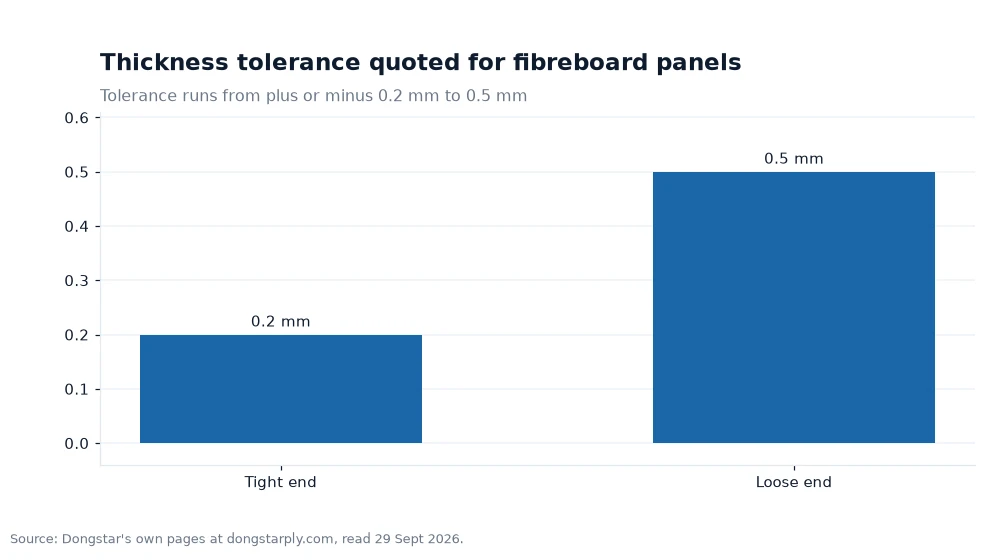
The published surface list for Dongstar's fibreboard range has five entries: matt, textured, glossy, embossed and magic. Underneath them sit four base boards and a choice of melamine paper, HPL, PVC or leather as the face, with thickness tolerance held between ±0.2 mm and ±0.5 mm. Which finish earns its place depends less on taste than on how the panel is handled.

Key takeaways
- Five treatments are listed — matt, textured, glossy, embossed and magic — and each one changes how a panel is cleaned and cut.
- Any finish can sit on four base boards: raw MDF, MHR MDF, FR MDF or HDF.
- Tolerance of ±0.2 mm to ±0.5 mm decides whether a glossy butt joint reads as a line or a shadow.
- Face material and finish are separate choices; melamine paper, HPL, PVC and leather behave differently at an edge.
Five treatments, five different working rules
A finish is not a coat of paint, and the differences show up in handling rather than in a photograph. Matt and smooth surfaces take a pencil line and a scribe without complaint. Glossy and high gloss surfaces show every fingerprint and every scratch picked up in transit, so they want protective film and careful stacking. Textured and embossed surfaces hide more than they reveal, which makes them forgiving on a large flat wall and awkward to clean where grease collects.
On a Medium Density Fibreboard panel, choosing between them is really a question about who touches the board after it leaves the factory. A kitchen fitter cutting a glossy door on a bench wants the film left on until the last minute. A shopfitter fixing embossed wall panels wants a surface that survives a bump from a trolley. A joiner building a wardrobe interior may simply want the least costly finish that wipes clean, which is usually a smooth matt face.
Matt and smooth: the workshop default
Matt is the finish most orders land on, and not by accident. It reflects little light, so it reads the same on a north-facing wall and under a work lamp, and joiners can sand a filled edge without the repair announcing itself. On a working surface a matt face also hides the fine scuffing that every installed panel collects in its first year. For carcass interiors and cabinet backs, where appearance matters least, it is the sensible default.
Smooth is the same story told slightly differently: the surface is flat enough to laminate and flat enough to accept an adhesive film without air blisters. Both finishes depend on the board being flat to start with, which is where the published thickness tolerance enters. A board held to ±0.2 mm sits comfortably in a laminating press, while panels drifting to the ±0.5 mm end of the band need more pressure and more attention at the joint.
Glossy and high gloss: where reflection is the point
Gloss earns its cost in shops, hotel lobbies and anywhere a client wants the surface to look like lacquer. A flat high gloss panel, correctly lit, has real depth — it reflects the room rather than absorbing it. The same quality is the reason it is unforgiving: any bow in the substrate, any filler in a joint, any scratch in transit shows as distortion. Buyers who specify gloss are really specifying a flatter board, a tighter tolerance and better packaging.
The practical consequence is that gloss work tends to be ordered in small runs of large panels rather than in many cut pieces. Fewer joints mean fewer places where a reflection can break, and fewer edges to band with a film that has to match the face exactly. If a design calls for gloss doors on a matt carcass, the two finishes also age differently, which is worth saying out loud in the specification.
Textured and embossed: grip, depth and camouflage
Textured and embossed surfaces are built for contact. A raised grain pattern gives a hand something to read, which suits door faces, wardrobes and panels that will be pushed more than admired. The texture also breaks up light, so a large run of wall panels does not become one long mirror of glare. Embossed finishes sit deeper and can be paired with a printed decor to give wood effects a relief that a flat print cannot imitate.
Where they lose is in cleaning and in repair. Grease and dust settle into the low points of a deep embossed pattern, so a kitchen splashback in that finish needs a brush rather than a cloth. A scratch that crosses a raised grain is difficult to disguise because it interrupts a pattern rather than a flat plane. In circulation areas that is a fair trade for grip and appearance; on a working top it usually is not.
The core under the finish still has to be chosen
Finishes are the visible layer, and behind the visible layer sits a base board with a job of its own. Four are offered: raw MDF, moisture-resistant MHR MDF in green, fire-retardant FR MDF in red and HDF in black. A gloss bathroom vanity panel on a green core will outlast the same panel on a raw core, and a corridor panel on the red core is what an interior fire brief is actually asking for.
The face material adds a third layer of choice. Melamine paper gives the widest colour range at the lowest weight; HPL is thicker and more resistant to impact; PVC brings flexibility and a matching edge band; leather changes the character of the whole panel. Because those four behave differently when trimmed, the finish on the drawing should always be written together with the face and the core rather than on its own line.
| Finish | How it reads | Where it holds up |
|---|---|---|
| Matt | Low reflection, uniform | Carcass interiors, cabinet backs, wall panels |
| Smooth | Flat, even, lamination-ready | Bench work, laminating runs, doors |
| Glossy | Reflective, high contrast | Shopfitting, lobbies, display faces |
| Embossed | Deep relief over a printed decor | Wardrobes, doors, decorative linings |
| Textured | Finely patterned, non-mirror | High-contact panels, hand-worn surfaces |
Worked example: panels for a 90-door run
A shopfitter needs 90 door fronts at 600 × 1200 mm each. Per door that is 0.6 m × 1.2 m = 0.72 m², so the job covers 90 × 0.72 = 64.8 m² of finished face (example). Cut from the 1220 × 2440 mm format, each sheet measures 1.22 m × 2.44 m = 2.98 m², and 64.8 ÷ 2.98 = 21.7, which rounds to 22 sheets (example).
The same job in the larger 2100 × 2500 mm format is 2.1 m × 2.5 m = 5.25 m² per sheet, so 64.8 ÷ 5.25 = 12.3, or 13 sheets (example). That format is quoted at 9 mm and below, so it suits thin door skins rather than a 15 mm door. Whichever route is taken, the finish sets the packing: a glossy or embossed face wants film and interleaving, and the ±0.5 mm end of the thickness band is the figure that decides how much of it is needed.
Frequently asked questions
Does a gloss finish need a different board underneath?
It needs a flatter one. Reflection amplifies any bow, so gloss work benefits from panels sitting at the tight end of the published ±0.2 mm to ±0.5 mm band, and from packaging that keeps the face protected until installation.
Are the finishes available on every thickness?
The finish is applied to the board, so it follows the board's limits. The 2100 × 2500 mm format works out at offered at 9 mm and as standard below, while thicker panels in the range use 1220 × 2440 mm, and both can carry any of the five listed treatments.
Which finish is easiest to keep clean?
Matt and smooth faces wipe clean with the least effort because there is no relief to trap dust. Textured and embossed surfaces need more attention — a deep pattern in a kitchen or a workshop collects grease in its low points and rewards a brush over a cloth.
Match the finish to the room, not to the sample book
Sample books are lit to flatter. What settles a finish choice is traffic, cleaning and light: who pushes a trolley past the panel, who wipes it, and whether a window faces it. Panels that have to survive contact usually leave the factory in a textured face over a stable core, and the fibreboard set within the panel catalogue gives the core options for exactly that kind of decision. Where a printed decor has to match an existing scheme, the melamine-faced panels are the range to compare against.
Finish names, base board options and tolerance figures are based on the maker's site, read 29 Sept 2026, as applied to these notes, for the numbers in this briefing[1].